
Intelligent Document Processing
Organisations process thousands of documents every day, but manually extracting information is slow, costly and prone to error. Intelligent Document Processing (IDP) uses Artificial Intelligence (AI), OCR and machine learning to classify documents, extract key business information and deliver trusted data directly into business systems. By automating document understanding, IDP improves accuracy, reduces manual effort and accelerates digital transformation.
What is Intelligent Document Processing (IDP)?
Intelligent Document Processing (IDP) is the use of Artificial Intelligence (AI) to automate the understanding of business documents. Unlike traditional document capture, which focuses on creating searchable digital documents, IDP identifies document types, extracts important business information, validates the results and prepares trusted data for use within business applications.
Modern IDP solutions combine technologies such as Optical Character Recognition (OCR), machine learning, natural language processing (NLP) and business rules to process both structured documents, such as forms and invoices, and unstructured documents, including emails, contracts and correspondence.
Where confidence levels are low or business rules require human judgement, documents can be automatically routed for review before information is committed to downstream systems.
By reducing manual data entry and improving the quality of business information, Intelligent Document Processing enables organisations to process documents faster, improve compliance and make better-informed decisions based on trusted digital information.
Paper2Process: Intelligent Document Processing is the use of Artificial Intelligence to classify documents, extract business information and create trusted digital data that can be validated, governed and integrated into business processes.
Structured Documents v Unstructured Documents
Not all business documents are the same. Some follow a consistent layout with predictable fields, while others contain free-flowing text that requires interpretation. Understanding the different document types is essential when selecting an Intelligent Document Processing (IDP) solution, as the level of automation and AI required varies significantly.


Structured Documents
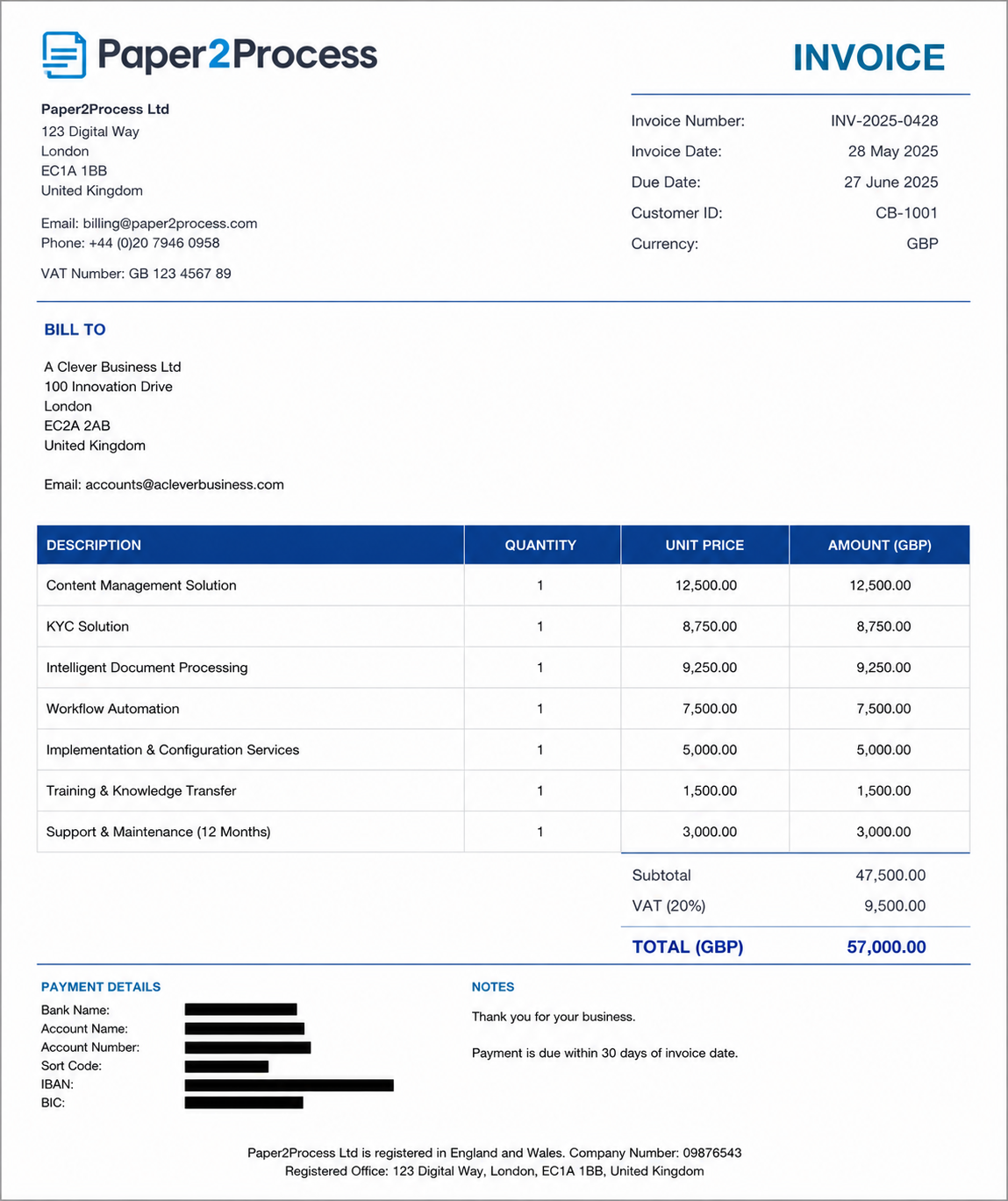
Structured documents have a fixed layout with information appearing in consistent locations. Examples include invoices, application forms, purchase orders and standard questionnaires. Because the structure is predictable, information such as invoice numbers, dates and totals can be extracted with a high degree of accuracy. (The invoice above is an example of a structured document)
Semi-Structured Documents
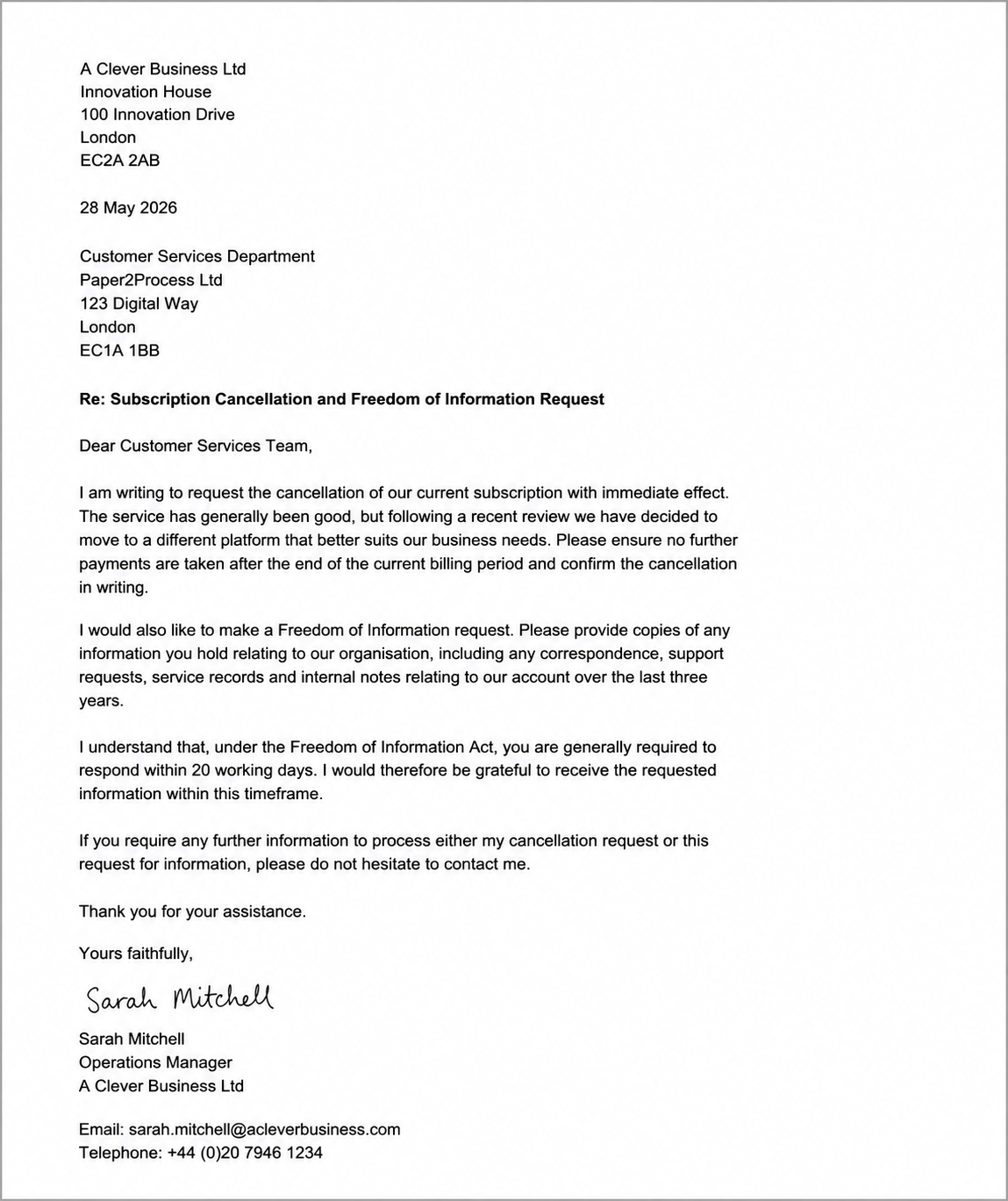
Semi-structured documents contain recognisable elements, but the layout can vary between organisations or document types. Examples include utility bills, bank statements, insurance forms and delivery notes. AI and business rules are typically required to identify and extract the relevant information. (the letter above is a semi structured document)
Unstructured Documents
Unstructured documents have no fixed format and are written in natural language. Letters, emails, contracts, customer correspondence and reports all fall into this category. Processing these documents requires Artificial Intelligence and Natural Language Processing (NLP) to understand the context, identify intent and extract meaningful business information.
Paper2Process: The more unstructured a document becomes, the more important Artificial Intelligence becomes. While traditional OCR can read text, Intelligent Document Processing understands what that information means and how it should be used.
Technologies behind Intelligent Document Processing (IDP).
Intelligent Document Processing combines several complementary technologies to understand business documents and transform them into trusted digital information. While Artificial Intelligence often receives the most attention, successful IDP solutions rely on a combination of technologies working together to accurately classify documents, extract information and validate results.
Optical Character Recognition (OCR)
Converts images of text into machine-readable text.
OCR is the foundation of most IDP solutions. It reads printed or handwritten text from scanned documents and converts it into digital text that can be searched, analysed and processed.
Typical use: Reading invoice numbers, names, addresses and document text.
Artificial Intelligence (AI)
Enables computers to make intelligent decisions about documents.
Artificial Intelligence helps identify document types, recognise patterns, interpret information and improve processing accuracy over time. AI enables IDP to work with documents that vary in layout and complexity.
Typical use: Identifying whether a document is an invoice, contract, application form or customer letter.
Machine Learning (ML)
Learns from previous processing to improve future accuracy.
Machine Learning analyses corrections made by users and uses that knowledge to improve future document processing. The more documents processed, the more accurate the system can become.
Typical use: Improving extraction accuracy for supplier invoices with different layouts.
Natural Language Processing (NLP)
Understands the meaning and context of written language.
Natural Language Processing enables systems to interpret free-form text rather than simply recognising words. It helps identify intent, sentiment, entities and relationships within emails, letters, contracts and other unstructured documents.
Typical use: Understanding that a customer letter contains both a cancellation request and a complaint.
Computer Vision
Interprets the visual structure of documents.
Computer Vision analyses document layouts, tables, checkboxes, signatures, logos and handwritten annotations. Rather than simply reading text, it understands how information is organised on the page.
Typical use: Identifying table rows on an invoice or recognising tick boxes on an application form.
Business Rules
Applies organisational logic to validate information.
Business rules verify extracted information against predefined conditions or external systems. They help ensure that only trusted, accurate information enters business processes.
Typical use: Confirming that invoice totals are correct or that mandatory fields have been completed before processing continues.
Confidence Scoring
Measures how certain the system is about its decisions.
Rather than assuming every extraction is correct, IDP solutions assign confidence scores to extracted information. Low-confidence results can be automatically routed for human review, improving both accuracy and trust.
Typical use: Flagging an unclear invoice number for manual validation before it is posted to an ERP system.
Paper2Process: No single technology makes Intelligent Document Processing possible. The most successful solutions combine OCR, Artificial Intelligence, Machine Learning, Natural Language Processing, Computer Vision and business rules to create trusted business information. The real value lies not in the individual technologies, but in how they work together to deliver accurate, reliable and actionable data.
How Intelligent Document Processing works
Intelligent Document Processing transforms business documents into trusted digital information by combining Artificial Intelligence, Optical Character Recognition (OCR), business rules and human validation. Rather than simply reading documents, IDP understands their content, extracts key business information and delivers trusted data directly into business systems.

Paper2Process: The objective of Intelligent Document Processing is not simply to automate document processing—it's to create trusted digital information. The most successful implementations combine AI with business rules and human oversight to ensure information is accurate before it enters critical business systems.
Intelligent Document Processing delivers far more than faster document handling. By combining Artificial Intelligence with automation and human oversight, organisations can reduce manual effort, improve data quality and accelerate business processes. The result is trusted digital information that supports better decision-making, stronger compliance and a more efficient way of working.
Reduce Manual Entry
Manual data entry is time-consuming, repetitive and one of the most common sources of business error. Intelligent Document Processing automatically extracts key information from business documents, significantly reducing the need for employees to manually enter data into business systems. This allows staff to focus on higher-value activities while improving both productivity and operational efficiency.
Strengthen Compliance
Consistent document processing, comprehensive audit trails and configurable business rules help organisations meet regulatory and governance requirements. Human review can be introduced whenever confidence levels are low, ensuring critical decisions remain under appropriate oversight while maintaining compliance and reducing operational risk.
Operational Business Value
Improve Accuracy
By combining Artificial Intelligence, Optical Character Recognition (OCR) and business validation rules, Intelligent Document Processing helps ensure that information is captured consistently and accurately. Automated validation and confidence scoring reduce human error, improve data quality and ensure trusted information is delivered into downstream business systems.
Operational Efficiency
Automating document-intensive processes enables organisations to process significantly higher document volumes without increasing headcount. Employees spend less time handling paperwork, while standardised processes reduce bottlenecks, improve consistency and lower the overall cost of document processing.
Accelerate Business Processes
Documents can be classified, understood and processed in seconds rather than hours or days. By eliminating manual sorting, data entry and repetitive administrative tasks, organisations can respond faster to customers, accelerate approvals and significantly reduce document processing times across the business.
Create trusted Business Information
The true value of Intelligent Document Processing lies not in reading documents, but in creating trusted business information. By transforming unstructured content into validated, structured digital data, organisations can integrate accurate information directly into ERP, CRM, HR, finance and other business applications, enabling better reporting, smarter decisions and more effective automation.
Regulations, Compliance & Governance
As organisations increasingly use Artificial Intelligence to automate document processing and business decisions, regulatory compliance and governance have become critical considerations. Intelligent Document Processing can help organisations improve compliance by creating accurate, traceable and auditable business information. However, organisations remain responsible for ensuring AI is deployed transparently, securely and with appropriate human oversight.
European Union AI Act (EU AI Act)
The European Union AI Act is the world's first comprehensive legislation governing the use of Artificial Intelligence. It introduces a risk-based framework that places obligations on organisations using AI, particularly where systems support decisions affecting individuals, financial services, healthcare, employment or public administration.
For Intelligent Document Processing, the Act highlights the importance of data quality, transparency, explainability, human oversight and accountability. Organisations should ensure AI assists business processes while allowing people to validate exceptions and retain responsibility for critical decisions.
GDPR & Data Protection
Many documents processed by IDP contain personal or sensitive information. Organisations must ensure personal data is collected, processed and stored in accordance with the UK GDPR and EU GDPR. Appropriate security controls, audit trails, access permissions and retention policies are essential to protect personal information and demonstrate compliance.
Industry Regulations
Many sectors have additional regulatory obligations governing document handling and information processing.
Examples include:
-
Financial Services (KYC, AML, FCA)
-
Healthcare (patient records and clinical governance)
-
Insurance and Claims Management
-
Legal Services
-
Government and Public Sector
Intelligent Document Processing helps organisations apply consistent business rules, reduce manual errors and maintain reliable audit evidence across document-intensive processes.
Audit & Explainability
Modern IDP solutions should provide a complete audit trail showing how information was extracted, validated and approved. Confidence scoring, exception handling and human review help organisations demonstrate that automated decisions are transparent, explainable and supported by appropriate governance.
Information Security
Business documents frequently contain confidential, commercially sensitive or regulated information. When selecting an IDP platform, organisations should evaluate encryption, identity management, role-based access controls, secure cloud infrastructure, data residency options and compliance with recognised security standards.
Human Oversight
Artificial Intelligence should enhance—not replace—human judgement. The most effective IDP solutions identify uncertainty, route low-confidence extractions for review and ensure that critical business decisions remain under appropriate human control. This is not only good business practice but is increasingly expected under emerging AI regulations.
Is Intelligent Document Processing (IDP) right for your Organisation?
Ask yourself the following questions:
☐ Do employees spend significant time manually entering information from business documents?
☐ Are invoices, forms, contracts or correspondence processed manually?
☐ Do errors occur because information is re-keyed into multiple business systems?
☐ Do employees spend time reading documents simply to identify key information?
☐ Are document processing times delaying customer service, payments or business decisions?
☐ Do you process both structured and unstructured documents?
☐ Would faster, more accurate data extraction improve business performance?
☐ Are you looking to introduce Artificial Intelligence into your document processes?
☐ Do you need greater confidence, auditability and human oversight when processing business information?
☐ Would trusted digital information improve reporting, automation and decision-making across your organisation?
If you answered "Yes" to three or more of these questions, Intelligent Document Processing could help your organisation reduce manual effort, improve data accuracy, accelerate business processes and create trusted digital information that supports automation, compliance and better business decisions.

Almost every organisation receives business information in the form of documents. Whether paper-based, scanned, emailed or digitally generated, these documents often contain valuable information that must be extracted, validated and entered into business systems. Intelligent Document Processing is used across virtually every industry to automate these repetitive, document-intensive processes.
Where is Intelligent Document Processing used?
Accounts Payable
Automatically capture invoice data, validate supplier information, match purchase orders and route invoices for approval, reducing manual processing and accelerating payment cycles.
Financial Services
Extract information from customer applications, identity documents and compliance paperwork to support Know Your Customer (KYC), Anti-Money Laundering (AML) and loan processing activities.
Human Resources
Automate the processing of employee documentation throughout the employment lifecycle, reducing administration and improving compliance.
Insurance
Automate the processing of employee documentation throughout the employment lifecycle, reducing administration and improving compliance.
Healthcare
Extract patient information from referrals, consent forms and clinical documents to reduce administrative workloads while improving data accuracy.
Legal Services
Automate the classification and extraction of information from legal documentation, improving efficiency while maintaining governance and auditability.
Government & Public Sector
Improve citizen services by automating high-volume document processing while maintaining compliance, transparency and auditability.
Mailroom Automation
Automatically classify incoming paper and digital correspondence before routing information into business workflows, reducing manual sorting and improving response times.
Document Types
Supplier Invoices | Purchase Orders | Credit Notes | Delivery Notes | Loan Applications | Bank Statements | Proof of Identity | Proof of Address | Customer Onboarding Forms | Employment Contracts | CVs | Résumés | Right-to-Work Documents | Payroll Forms | Performance Reviews | Claim Forms | Accident Reports | Medical Reports | Photographic Evidence | Customer Correspondence | Patient Registration Forms | Referral Letters | Clinical Records | Consent Forms | Laboratory Reports | Contracts | Court Documents | Legal Correspondence | Case Files | Due Diligence Documentation | Applications | Licences | Permits | Tax Forms | Benefit Claims | Customer Applications | Financial Statements | Supporting Evidence | Commercial Contracts | Supplier Agreements | Non-Disclosure Agreements (NDAs) | Service Agreements | Procurement Contracts | Letters | Emails | Complaint Documentation
Bring your own Artificial Intelligence (BYOAI)
Many Intelligent Document Processing solutions include their own built-in Artificial Intelligence models for document classification, information extraction and document understanding. While these models are often highly capable, some organisations prefer to use their own approved AI services as part of their wider AI strategy.
Leading IDP platforms increasingly support a Bring Your Own AI (BYOAI) approach, allowing organisations to integrate services such as Google Gemini, Microsoft Azure OpenAI, Anthropic Claude or internally developed Large Language Models (LLMs). This enables organisations to benefit from the workflow, validation, exception handling and governance capabilities of the IDP platform while standardising on a single enterprise AI platform across the business.
This approach can provide greater flexibility, allowing organisations to adopt new AI models as they emerge, maintain greater control over data processing and ensure compliance with internal AI governance policies. It also helps protect organisations from becoming dependent on a single vendor's proprietary AI technology.
Paper2Process Advice: When evaluating an Intelligent Document Processing solution, don't just ask how good its AI is. Ask whether it gives you the flexibility to use the AI platform your organisation has already standardised on. The strongest IDP platforms treat Artificial Intelligence as a service that can evolve over time, rather than locking customers into a single proprietary model.
The top Suppliers





Other Leading Suppliers
The Intelligent Document Processing market continues to evolve rapidly, with a growing number of vendors combining Artificial Intelligence, Optical Character Recognition (OCR), machine learning and workflow automation to deliver document understanding capabilities. While the suppliers featured above are among the industry's leading platforms, many other vendors provide excellent Intelligent Document Processing solutions. Platforms from Rossum, Hyperscience, M-Files, UiPath, Ephesoft, Parascript, Infrrd, Nanonets, Klippa and Super.AI each offer specialist capabilities and may be a better fit depending on your document types, processing volumes, existing business applications, Artificial Intelligence strategy, integration requirements, industry-specific needs and wider digital transformation objectives.
Paper2Process buyer's guide
Selecting an Intelligent Document Processing (IDP) solution is about far more than choosing the platform with the most impressive Artificial Intelligence. A successful implementation requires the right balance of technology, governance, integration and business process expertise. Get it right and IDP can transform how your organisation processes information. Get it wrong and you can spend a significant amount of money on a solution that delivers poor accuracy, frustrated users and little return on investment.
Before selecting a solution, consider the following questions.
Define the business problem
Start by identifying the business challenge you are trying to solve rather than the technology you want to buy. Whether your objective is reducing manual data entry, accelerating invoice processing, improving customer onboarding or increasing compliance, your success should be measured against clear business outcomes.
Understand your documents
Evaluate the types of documents your organisation processes. Structured, semi-structured and unstructured documents all present different challenges, and understanding your document landscape will help determine the level of Artificial Intelligence required.
Look beyond OCR
Optical Character Recognition (OCR) is only one component of Intelligent Document Processing. Look for solutions that combine document classification, Artificial Intelligence, business rules, validation, confidence scoring and human review to create trusted digital information.
Evaluate Artificial Intelligence carefully
Don't be distracted by impressive demonstrations. Ask how the AI is trained, how extraction accuracy is measured, how exceptions are handled and whether the platform allows you to integrate your own enterprise AI services, such as Google Gemini or Microsoft Azure OpenAI.
Prioritise integration
The value of Intelligent Document Processing comes from how well it integrates with your existing business applications. Ensure the solution connects easily with your ERP, CRM, HR, finance, document management and workflow platforms without requiring extensive custom development.
Don't ignore human oversight
No Artificial Intelligence solution is perfect. The best IDP platforms provide confidence scoring and validation workflows that allow users to review low-confidence results before information enters business systems. This improves data quality while supporting regulatory compliance.
Think about governance
Review the platform's security, audit capabilities, access controls, data residency options and compliance with regulations such as the EU AI Act and GDPR. Governance should be designed into the solution from the beginning, not added later.
Plan for future growth
Your first use case is unlikely to be your last. Choose a platform that can support additional document types, departments and business processes as your organisation's automation strategy evolves.
Consider the total cost of ownership
Software licensing is only part of the investment. Consider implementation services, AI model training, integration, support, maintenance, infrastructure and ongoing optimisation. A lower-cost platform can quickly become the more expensive option if it requires significant customisation or manual intervention.
Paper2Process Advice: Intelligent Document Processing projects often represent a substantial investment. It is surprisingly easy to spend a significant amount of money on the wrong platform if you focus on demonstrations rather than real business requirements. Choose a solution that delivers trusted digital information, integrates with your existing systems, supports strong governance and can grow with your organisation. The most successful IDP projects are built around business outcomes—not Artificial Intelligence alone.
What to Look for in an Intelligent Document Processing Solution
Not all Intelligent Document Processing solutions offer the same capabilities. While many can extract information from documents, the best platforms combine Artificial Intelligence, business rules, workflow and governance to create trusted digital information. When comparing solutions, look beyond OCR and evaluate the features that will have the greatest impact on accuracy, automation, compliance and long-term business value.
⭐⭐⭐⭐⭐
Extraction accuracy & document understanding
The primary purpose of an Intelligent Document Processing solution is to accurately understand documents and extract meaningful business information. Look for platforms that can classify documents, identify key data and maintain high levels of accuracy across structured, semi-structured and unstructured content.
⭐⭐⭐⭐⭐
Artificial Intelligence & model flexibility
Modern IDP solutions should support more than just built-in AI. Increasingly, organisations want the flexibility to use their own enterprise AI services, such as Google Gemini or Microsoft Azure OpenAI, while retaining the workflow, governance and validation capabilities of the IDP platform.
⭐⭐⭐⭐⭐
Human validation & confidence scoring
No AI solution is 100% accurate. The best platforms use confidence scoring to identify uncertain results and route them for human review before information enters business systems. This improves data quality while supporting governance and regulatory compliance.
⭐⭐⭐⭐☆
Integration & business connectivity
Artificial intelligence can improve both speed and accuracy by automating document analysis, fraud detection and decision-making. Look for platforms that combine intelligent automation with appropriate human oversight where higher-risk decisions are involved.
⭐⭐⭐⭐☆
Security, governance & compliance
Business documents frequently contain confidential or regulated information. Look for strong security, encryption, role-based access controls, audit trails and support for regulations such as GDPR and the EU AI Act to ensure information is processed responsibly.
⭐⭐⭐⭐☆
Ease of implementation & scalability
The best platforms are straightforward to deploy and capable of growing with your organisation. Consider how easily new document types, departments and business processes can be added without extensive development or ongoing consultancy costs. While important, scalability only delivers value if the core AI and information extraction capabilities are already strong.
Creating a connected Information Management Platform
The solutions featured across Paper2Process are inherently linked. Modern organisations rarely deploy these technologies in a vacuum. By integrating document capture, intelligent processing, electronic signatures, and record management, you create a cohesive and resilient digital ecosystem. Explore how these capabilities unify to drive operational agility, bolster security, and deliver reliable business outcomes across your entire enterprise architecture.
01
Deliver seamless joining experiences that boost conversion and loyalty.
02
Ensure rigorous security and regulatory compliance with automated checks.
03
Gain full visibility and control over legal agreements from start to finish.
04
Reduce cycles and eliminate errors with touchless financial workflows.
05
Digitise high volumes of paper and data and turn them into usable assets.
06
Centralise your information to enable instant access and secure storage.
07
Leverage AI to classify and extract critical data from complex documents.
08
Automate governance to ensure long-term compliance and risk mitigation.
09
Execute agreements faster with secure, legally binding digital signing.
10
Streamline complex tasks to improve employee productivity and service speed.