
Workflow Automation
Workflow automation digitises and automates business processes by routing information, documents and tasks to the right people at the right time, improving efficiency, compliance and operational control.
What is Workflow Automation?
Workflow automation is the process of digitally managing, routing and automating business tasks, approvals and information as they move through an organisation. By replacing manual processes with predefined business rules, organisations can improve efficiency, reduce delays and ensure work is completed consistently and accurately.
Many organisations still rely on emails, spreadsheets and paper documents to manage approvals and business processes. These manual methods often result in bottlenecks, lost information, inconsistent decision-making and unnecessary administrative effort.
Modern workflow automation solutions use digital forms, document capture, Artificial Intelligence (AI), business rules and automated routing to move information to the right people at the right time. Tasks can be approved, rejected or escalated automatically, while managers gain complete visibility into process performance and outstanding work.
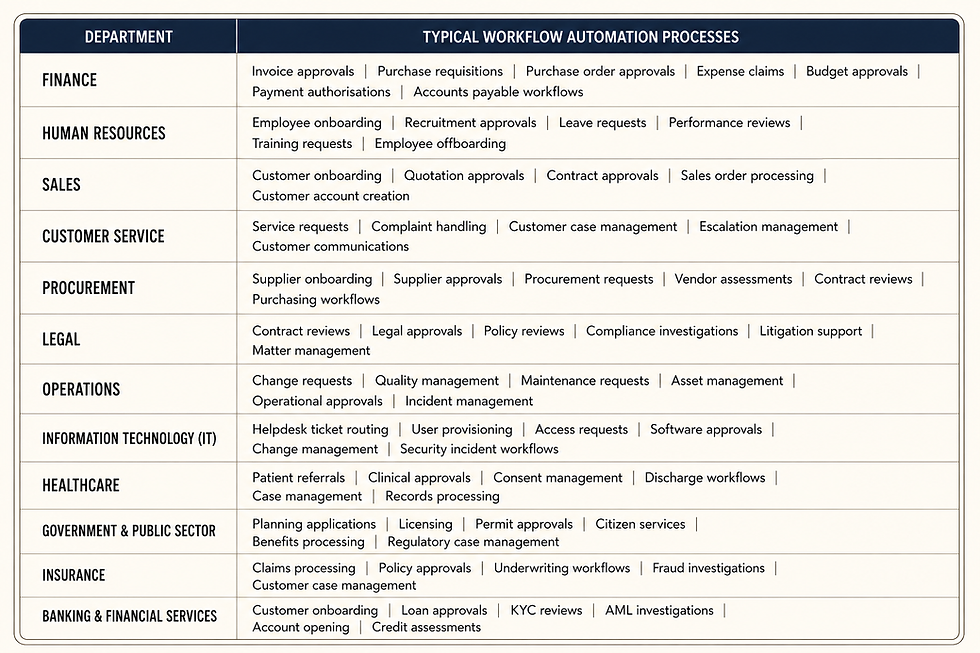
Workflow automation can be applied to virtually any business process, including customer onboarding, invoice approvals, contract reviews, HR requests, expense claims, procurement, document approvals and case management. By automating repetitive tasks and standardising processes, organisations can improve productivity, strengthen compliance and deliver faster, more consistent business outcomes.

Digitise, automate and optimise business processes by routing information, tasks and approvals to the right people at the right time.

INCREASE
PRODUCTIVITY
IMPROVE
VISIBILITY
ACCELERATE
DECISIONS
STRENGHTEN
GOVERNANCE
Regulatory, Legal and Compliance Considerations
Workflow automation plays a critical role in helping organisations demonstrate compliance, improve governance and standardise business processes. By automating approvals, enforcing business rules and maintaining comprehensive audit trails, workflow automation solutions help ensure tasks are completed consistently, securely and in accordance with organisational policies and regulatory requirements.
Data Protection and Privacy
Workflow automation often processes personal and commercially sensitive information. Organisations should ensure workflows comply with applicable data protection legislation, including the General Data Protection Regulation (GDPR), by implementing appropriate security, access controls and data handling procedures.
Governance and Internal Controls
Automated workflows help enforce business policies by ensuring approvals, reviews and decisions follow predefined rules. This strengthens internal controls, reduces operational risk and improves accountability across the organisation.
Audit Trails
Every action within a workflow should be recorded, creating a complete audit trail that demonstrates who performed each task, when decisions were made and how business processes were executed. This supports both internal governance and external regulatory audits.
Information Security
Workflow automation platforms should protect sensitive business information through role-based access controls, encryption and secure authentication. Many organisations also seek compliance with recognised information security standards such as ISO 27001.
Records Retention
Business processes often generate documents and records that must be retained for legal, regulatory or operational purposes. Workflow automation should support retention policies, secure archiving and controlled disposal in accordance with applicable legislation.
Industry-Specific Compliance
Many sectors, including financial services, healthcare, legal services, government and telecommunications, have additional regulatory requirements governing approvals, record keeping and operational processes. Workflow automation helps organisations demonstrate compliance while reducing manual effort and improving operational consistency.
Do I need to worry about Workflow Automation?
If your organisation relies on manual processes, emails or spreadsheets to manage approvals and business activities, workflow automation should be an important consideration. By automating repetitive tasks, routing work to the right people and enforcing consistent business rules, workflow automation improves productivity, increases process visibility, strengthens governance and helps organisations deliver faster, more efficient business outcomes.
VERDICT: Every organisation has workflows. The question is whether they are managed manually or intelligently. Workflow automation enables organisations to work smarter, respond faster and operate with greater control and confidence.
Is Workflow Automation right for your organisation?
Answer the following questions:
☐ Do business processes rely on emails, spreadsheets or paper forms?
☐ Do approvals regularly cause delays or bottlenecks?
☐ Are employees spending too much time on repetitive administrative tasks?
☐ Is it difficult to track the status of requests or approvals?
☐ Do you need greater consistency in how business processes are executed?
☐ Are audit trails and accountability important for governance or compliance?
☐ Do your business systems operate in isolation rather than as an integrated process?
☐ Is improving operational efficiency a key business objective?
If you answered "Yes" to three or more of these questions, workflow automation is likely to deliver significant operational and financial benefits for your organisation.
The top Suppliers


The workflow automation market continues to evolve as organisations look to streamline business processes, improve operational efficiency and reduce manual administration. While the suppliers featured above are among the industry's leading providers, many other organisations offer excellent workflow automation solutions. Vendors such as Camunda, Bizagi, Kissflow, Pipefy, ProcessMaker, Laserfiche, Creatio, IBM Business Automation Workflow, Oracle Process Automation and SAP Build Process Automation each provide specialist capabilities and may be a better fit depending on your organisation's size, industry, integration requirements and process complexity.
What features should you look for in a Workflow Automation Solution?
The right workflow automation solution should do more than simply route tasks from one person to another. It should help your organisation automate business processes, improve productivity, strengthen governance and provide complete visibility into every stage of a workflow. When comparing solutions, consider the following capabilities.
Can it automate complex business processes?
Look for a solution that can automate both simple approvals and multi-stage business processes involving multiple departments, decisions and business rules.
Can it intelligently route work?
Tasks, documents and requests should be routed automatically to the right people based on predefined rules, reducing delays and eliminating manual intervention.
Does it support configurable business rules?
The platform should allow organisations to define approval rules, escalation paths, conditions and exceptions without requiring extensive software development.
Will it integrate with your existing systems?
Workflow automation should integrate seamlessly with CRM, ERP, HR, finance, document management and other business applications to create connected, end-to-end processes.
Can it provide real-time visibility?
Dashboards and reporting should allow managers to monitor workflow status, identify bottlenecks and measure process performance.
Does it automate notifications and escalations?
Automatic reminders, notifications and escalations help ensure tasks are completed on time while maintaining accountability throughout the process.
Can it adapt as your business evolves?
Business processes change over time. Choose a solution that allows workflows to be modified quickly without major redevelopment projects.
Does it provide comprehensive audit trails?
Every task, approval, decision and user action should be recorded, supporting governance, compliance and operational transparency.
How does it protect sensitive information?
Look for role-based access controls, encryption, authentication and security features that protect business information throughout the workflow.
Can it scale across the organisation?
The best workflow automation solutions can support multiple departments, thousands of users and hundreds of different business processes as your organisation grows.
What to Look for in a Workflow Automation Solution
Selecting a workflow automation solution is about more than routing tasks between people. The right platform should help your organisation automate business processes, improve productivity, increase visibility and strengthen governance while integrating seamlessly with your existing business systems. When comparing solutions, consider the following capabilities.
⭐⭐⭐⭐⭐
Workflow Design & Automation
Create and automate business processes using configurable workflows, business rules and approval paths that reduce manual effort and improve consistency.
⭐⭐⭐⭐⭐
Intelligent Task Routing
Automatically route tasks, documents and requests to the right people based on predefined rules, ensuring faster processing and eliminating bottlenecks.
⭐⭐⭐⭐⭐
Integration & Connectivity
Integrate seamlessly with CRM, ERP, HR, finance, document management and other business systems to create connected, end-to-end processes.
⭐⭐⭐⭐☆
Process Visibility & Reporting
Monitor workflow performance through real-time dashboards, reporting and analytics, providing complete visibility into every stage of the process.
⭐⭐⭐⭐☆
Notifications & Escalations
Automatically notify users of pending tasks, overdue approvals and exceptions, helping processes move quickly while maintaining accountability.
⭐⭐⭐⭐☆
Security & Audit Trails
Protect sensitive business information through role-based access controls, encryption and comprehensive audit trails that support governance, compliance and regulatory requirements.
Creating a connected Information Management Platform
The solutions featured across Paper2Process are inherently linked. Modern organisations rarely deploy these technologies in a vacuum. By integrating document capture, intelligent processing, electronic signatures, and record management, you create a cohesive and resilient digital ecosystem. Explore how these capabilities unify to drive operational agility, bolster security, and deliver reliable business outcomes across your entire enterprise architecture.
01
Deliver seamless joining experiences that boost conversion and loyalty.
02
Ensure rigorous security and regulatory compliance with automated checks.
03
Gain full visibility and control over legal agreements from start to finish.
04
Reduce cycles and eliminate errors with touchless financial workflows.
05
Digitise high volumes of paper and data and turn them into usable assets.
06
Centralise your information to enable instant access and secure storage.
07
Leverage AI to classify and extract critical data from complex documents.
08
Automate governance to ensure long-term compliance and risk mitigation.
09
Execute agreements faster with secure, legally binding digital signing.
10
Streamline complex tasks to improve employee productivity and service speed.